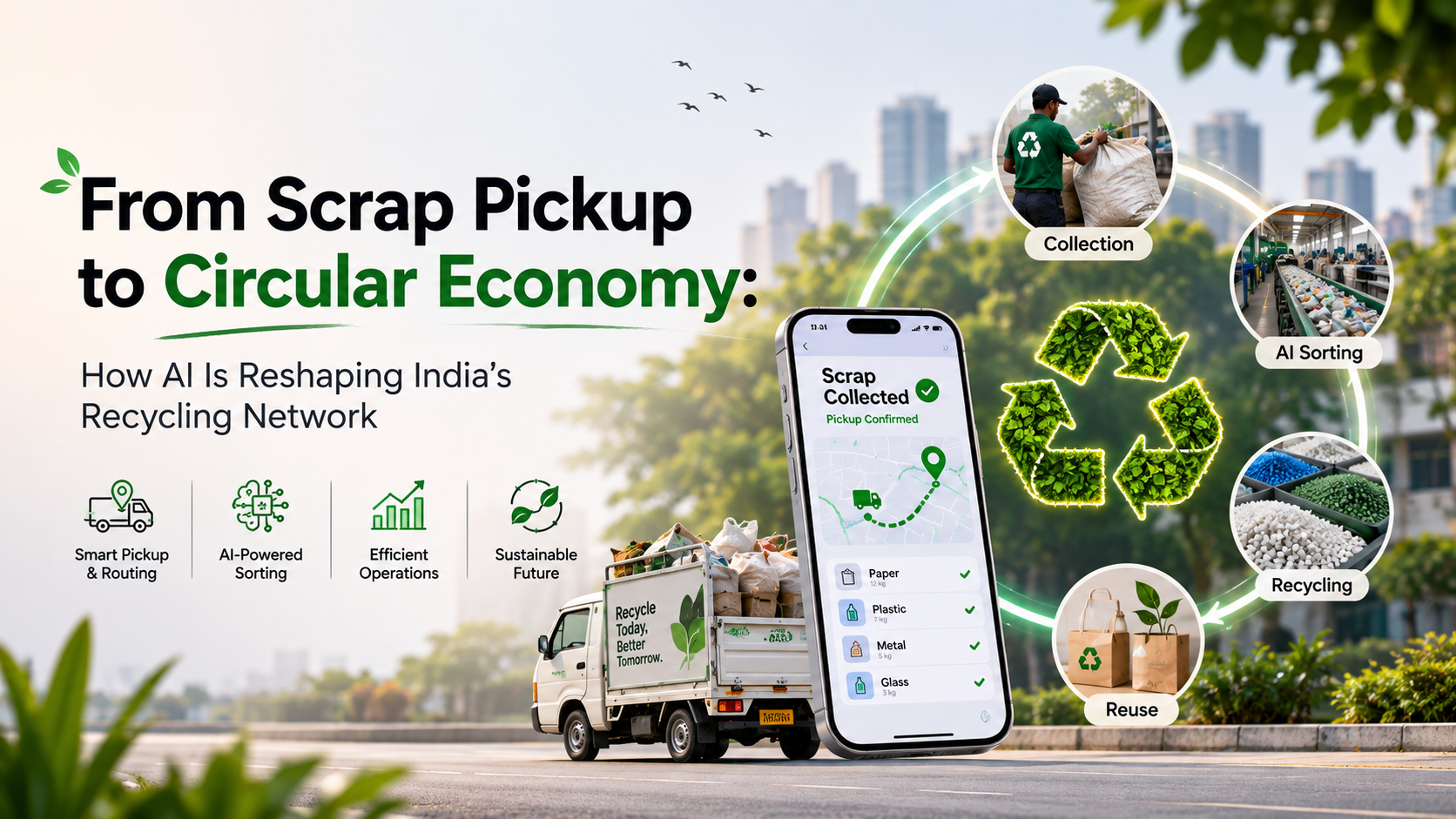
India’s recycling system is moving from fragmented scrap collection toward a more connected, data-driven circular economy. Artificial intelligence, Internet of Things (IoT) devices, computer vision, digital marketplaces, and traceability platforms are helping connect households, waste pickers, scrap dealers, aggregators, recyclers, manufacturers, and regulators.
The traditional kabadiwala network remains important, but digital tools can make it more visible, efficient, and connected to formal recycling infrastructure. Instead of treating discarded plastic, electronics, batteries, and packaging simply as waste, AI can help identify material value, improve collection and sorting, and route recovered materials toward suitable processors.
India’s Recycling Challenge
India’s recycling network includes municipal systems, formal recyclers, informal waste pickers, scrap shops, aggregators, producer organizations, and manufacturers. These participants often operate across fragmented supply chains with inconsistent data, changing prices, limited traceability, and different levels of technical capacity.
Common challenges include:
- Waste being mixed at the point of disposal.
- Limited information about material quality and composition.
- Inefficient pickup routes.
- Manual sorting and contamination.
- Inconsistent scrap pricing.
- Limited visibility into informal collection.
- Difficulty verifying recycling outcomes.
- Documentation challenges related to Extended Producer Responsibility (EPR).
- Limited access to digital tools among smaller collectors.
AI does not solve these issues on its own. Its value comes from connecting data, people, machines, and decisions across the recycling process.
From Local Scrap Pickup to Digital Collection
The first transformation is taking place at the collection stage. Digital platforms can connect households, businesses, waste pickers, scrap dealers, and recycling facilities through pickup requests, digital records, location data, and payment systems.
AI can support this layer by helping organizations:
- Predict where recyclable material is likely to be generated.
- Group nearby pickup requests.
- Match collection jobs with available workers.
- Estimate material type and approximate volume.
- Recommend collection times and routes.
- Track pickup completion.
- Record prices and payment details.
- Connect collected material with suitable buyers.
A digital platform can turn an isolated scrap transaction into a more traceable material flow, reflecting the rise of e-commerce and digital platforms in the recycling sector. This does not mean every informal collector needs to adopt complex software immediately. Simple mobile interfaces, local-language support, assisted onboarding, and digital payment options can help extend participation gradually.
The NITI Frontier Tech initiative has highlighted how AI, data, logistics intelligence, and digital marketplaces can help formalize parts of India’s waste ecosystem and improve material traceability.
AI-Optimized Collection and Routing
Collection costs are influenced by distance, traffic, fuel prices, vehicle capacity, pickup density, material value, and facility operating hours. Poorly planned routes can require several trips for small quantities of low-value material.
AI-powered routing systems can analyze:
- Historical pickup patterns.
- Real-time collection requests.
- Traffic conditions.
- Vehicle capacity.
- Fuel consumption.
- Material type and expected value.
- Driver availability.
- Facility operating hours.
- Weather and seasonal variations.
The system can then recommend which pickup requests should be grouped together and which routes are likely to be more efficient.
IoT-enabled smart bins can add another layer of information. Fill-level sensors can notify collection teams when containers require service, helping reduce unnecessary trips and overflow.
In India, such systems need to be designed for practical conditions such as dust, low connectivity, irregular power supply, and diverse collection environments.
Routing optimization is not only a cost-saving measure. Fewer unnecessary trips can reduce fuel consumption, vehicle emissions, traffic congestion, and operational pressure on collection teams.
Predicting Waste Supply
Recyclers and manufacturers need a reliable supply of usable material. However, the volume and quality of recyclable waste can vary by location, season, events, industry, weather, and consumer behavior.
Machine-learning models can analyze historical collection data to estimate:
- Expected plastic generation in a locality.
- Seasonal increases in packaging waste.
- Likely e-waste volumes from commercial areas.
- Battery waste from mobility and electronics markets.
- Material availability near recycling facilities.
- Future demand for recycled polymers or metals.
These forecasts can help aggregators and recyclers plan vehicles, labor, storage, processing capacity, and sales commitments.
Predictive analytics should be treated as an estimate rather than a guarantee. Its accuracy depends on reliable historical data and regular updates from the field.
Smart Sorting and Material Recovery
Sorting is one of the most important stages in recycling because the purity of recovered material affects its market value and processing options.
Mixed waste can contain different plastics, metals, paper, textiles, batteries, food residue, and hazardous components. Manual sorting remains essential in many locations, but it can be slow, inconsistent, and physically demanding.
AI-based sorting combines cameras, sensors, machine-learning models, conveyors, and robotic or mechanical systems to classify material more consistently.
Computer Vision
Computer-vision systems can identify objects by analyzing characteristics such as:
- Shape.
- Colour.
- Size.
- Texture.
- Labels.
- Surface patterns.
- Transparency.
- Visible contamination.
Advanced systems can distinguish recyclable items from rejects and separate different material categories on conveyor belts.
Optical and Spectral Identification
Cameras can be combined with near-infrared and other sensing technologies to identify materials that look similar to the human eye. This can be useful when sorting polymers such as PET, HDPE, and polypropylene.
AI can also support identification of multilayer packaging, additives, coatings, and contaminants. The effectiveness of these systems depends on the quality of the sensors, training data, waste stream, and operating environment.
Robotic Sorting
Robotic arms can remove selected items from conveyor lines after AI systems identify them. This can improve consistency and reduce exposure to sharp, toxic, or hazardous materials.
Automation should complement rather than automatically replace human workers. India’s recycling economy depends heavily on informal waste pickers and scrap dealers whose work supports collection, sorting, and material recovery. Responsible automation should focus on safety, productivity, training, and better working conditions.
An Indian Example: AI-Based Waste Sorting
India already has examples of AI-assisted sorting moving beyond the concept stage. NITI Frontier Tech has highlighted Ahmedabad-based Ishitva Robotic Systems and its AI-enabled sorting technology. Its systems use computer vision and automated sorting to identify and separate waste streams, illustrating how AI can be applied to material recovery in an Indian operating environment.
Quality Grading
AI can assess incoming material and classify it by quality, contamination, degradation, or processing suitability. Recyclers can then route each batch to the most suitable process instead of treating all material as identical.
Better quality grading can improve the production of post-consumer recycled (PCR) materials and help manufacturers purchase recycled feedstock with greater confidence.
Formalizing the Informal Recycling Economy
The informal sector is a central part of India’s waste-recovery network. Waste pickers and small scrap dealers collect, sort, aggregate, and sell materials that may otherwise be sent to landfills or remain outside formal systems.
Digital tools can support inclusion through:
- Digital worker or supplier profiles.
- Verified collection records.
- Transparent price information.
- Digital weighing and receipts.
- Instant or scheduled payments.
- Access to pickup requests.
- Health and safety information.
- Training and certification.
- Connections with formal recyclers.
Formalization should not mean excluding workers who lack smartphones, bank accounts, formal business registrations, or digital literacy. Platforms should offer assisted registration, multilingual interfaces, cash-to-digital support, and partnerships with local organizations.
Responsible recycling models should also consider fair compensation, occupational safety, social protection, and the role of women and other vulnerable workers in collection and sorting.
Traceability and EPR Compliance
Extended Producer Responsibility requires producers, importers, and brand owners to take responsibility for the collection, recycling, or appropriate management of products and packaging placed on the market.
AI and digital tracking can support EPR processes by recording:
- Material origin.
- Collection location.
- Collector or aggregator.
- Weight and material category.
- Transportation details.
- Processing facility.
- Recovered output.
- Recycling certificates.
- Final use of recycled material.
QR codes, digital IDs, GPS records, weighbridge data, invoices, and facility reports can create a more complete chain of evidence.
AI can help identify inconsistencies, such as:
- Recycling volumes that appear inconsistent with reported inputs.
- Duplicate records.
- Unusual weight patterns.
- Repeated transactions from the same source.
- Gaps between collection and processing.
- Certificates or records that require additional verification.
Digital records do not automatically guarantee authenticity. Data must be independently verified, systems must be protected from manipulation, and regulators and businesses should define clear audit standards.
Digital Marketplaces for Recyclable Materials
Recyclable material has different values depending on polymer type, purity, contamination, location, demand, and processing cost. Small collectors may not have access to transparent information about market prices or suitable buyers.
Digital marketplaces can connect:
- Households and businesses.
- Waste pickers.
- Scrap dealers.
- Aggregators.
- Material recovery facilities.
- Formal recyclers.
- Plastic processors.
- Packaging manufacturers.
- Brand owners.
AI can help match available material with buyers based on:
- Material type.
- Grade and quality.
- Quantity.
- Location.
- Delivery requirements.
- Price.
- Processing capability.
- Demand forecasts.
This can reduce information gaps and help improve transaction efficiency. However, digital marketplaces should clearly explain pricing, fees, quality standards, rejection policies, and payment timelines.
Closing the Loop for Manufacturers
AI can help move recycling beyond waste collection by connecting recovered material with manufacturing demand.
Predictive systems can estimate demand for:
- Recycled PET.
- Recycled HDPE.
- Recycled polypropylene.
- Recovered metals.
- Recycled paper.
- Battery materials.
- Reprocessed electronic components.
This allows recyclers to plan output according to buyer requirements and reduce the risk of producing material without a confirmed market.
Manufacturers can also use AI to improve product and packaging design. Simulation tools can assess whether a proposed material combination is easy to sort, recycle, reuse, or recover.
Packaging design can therefore consider the entire lifecycle rather than only production and appearance.
AI may also support the development of mono-material packaging, improved labelling, recyclable closures, and designs that reduce contamination during processing.
E-Waste and Battery Recycling
India’s growth in electronics, electric mobility, data centres, and consumer devices is increasing the importance of specialized recycling systems.
AI can assist e-waste and battery recycling by supporting:
- Device identification.
- Component classification.
- Battery chemistry recognition.
- Hazard detection.
- Reusable-part recovery.
- Material grading.
- Safe disassembly planning.
- Predictive maintenance.
- Collection forecasting.
Battery recycling requires particular care because damaged cells, residual charge, and chemical exposure can create fire and safety risks. AI systems may help identify risk categories, but trained personnel and approved safety procedures remain essential.
E-waste platforms can also use digital records to track devices from collection through dismantling, material recovery, and final processing. This improves accountability and helps ensure scrap materials and reusable waste products are properly recovered while reducing the risk of valuable or hazardous components entering unsafe channels.
Challenges and Responsible Implementation
AI-based recycling systems face several practical limitations.
Inconsistent Data
Waste streams vary significantly by city, neighborhood, season, facility, and collection method. Models trained in one environment may not perform equally well in another.
Contamination and Difficult Materials
Black plastics, multilayer packaging, wet waste, damaged electronics, and mixed materials can be difficult to classify accurately.
Infrastructure Limitations
Many collection points and small scrap shops may have limited connectivity, power, storage, or technical support.
Cost of Automation
Computer-vision systems, sensors, robotic equipment, software, maintenance, and staff training require investment. Smaller recyclers may need shared facilities, financing, or government support.
Worker Inclusion
Automation must not push informal workers out of the system without alternative livelihoods, training, or transition support.
Data Governance
Collection and payment platforms may process personal, financial, location, and business information. Strong access controls and privacy practices are necessary.
False Sustainability Claims
Digital records can improve transparency, from tracking recycling outcomes to documenting material value such as Car Scrap Value. However, businesses still need independent audits and verification to ensure these records accurately reflect actual recycling performance.
A Practical Roadmap for AI-Enabled Recycling
Businesses, municipalities, recyclers, and producer organizations can begin with a focused implementation plan:
- Define the waste stream: Identify whether the project focuses on plastic, e-waste, batteries, packaging, or mixed municipal waste.
- Map the participants: Document households, collectors, scrap dealers, aggregators, recyclers, manufacturers, and regulators.
- Start with reliable data: Standardize records for material type, quantity, location, quality, and processing.
- Pilot one workflow: Begin with route optimization, digital pickup, smart sorting, or traceability rather than attempting a complete transformation at once.
- Design for local conditions: Support low-connectivity environments, local languages, assisted onboarding, and affordable hardware.
- Measure meaningful outcomes: Track recovery rate, contamination, cost per pickup, fuel use, worker income, processing yield, and verified recycling volume.
- Protect workers and data: Include safety measures, fair payment, training, privacy controls, and human oversight.
- Scale through partnerships: Connect municipalities, recyclers, brands, technology providers, and informal-sector organizations.
Conclusion
AI is helping connect India’s fragmented recycling network by improving collection, sorting, traceability, and material recovery.
Through route optimization, predictive sourcing, computer-vision sorting, digital marketplaces, traceability, and demand forecasting, technology can help recover more material and return it to productive use.
But the success of AI in recycling will depend on more than algorithms. It will require reliable data, practical infrastructure, responsible automation, inclusive participation, transparent compliance, and collaboration between informal workers, formal recyclers, manufacturers, municipalities, brands, and policymakers.
The future of Indian recycling is not simply about replacing the local scrap collector with a machine. It is about connecting the strengths of the existing network with digital tools that improve safety, visibility, efficiency, and economic value across industrial scrap recovery.
Frequently Asked Questions
How is AI improving recycling in India?
AI can optimize collection routes, predict waste generation, identify materials, detect contamination, improve sorting, monitor facility performance, and connect recyclable material with suitable buyers.
Can AI replace waste pickers and scrap dealers?
AI and automation may reduce certain manual tasks, but informal recycling workers remain important to India’s collection and recovery network. Responsible systems should improve safety, productivity, income transparency, and access to formal markets rather than simply remove workers.
How does AI support plastic sorting?
Computer vision, cameras, optical sensors, and machine-learning models can identify plastic types, colours, shapes, labels, and contamination. Mechanical or robotic systems can then separate material into suitable streams.
How can AI support EPR compliance?
AI-enabled traceability systems can record collection, transportation, processing, weights, certificates, and recovered output. They can also flag duplicate records or inconsistencies for further review.
What role does IoT play in smart recycling?
IoT devices such as smart-bin sensors, GPS trackers, weighing systems, and facility monitors provide data that AI systems can use to improve routing, capacity planning, maintenance, and material tracking.
What are the biggest barriers to AI adoption in recycling?
The main barriers include inconsistent data, fragmented supply chains, technology costs, limited digital infrastructure, workforce concerns, difficult-to-sort materials, and the need for strong verification.
Market figures, policy requirements, regulatory obligations, and technology performance claims should be verified against the original source before publication or investment decisions.