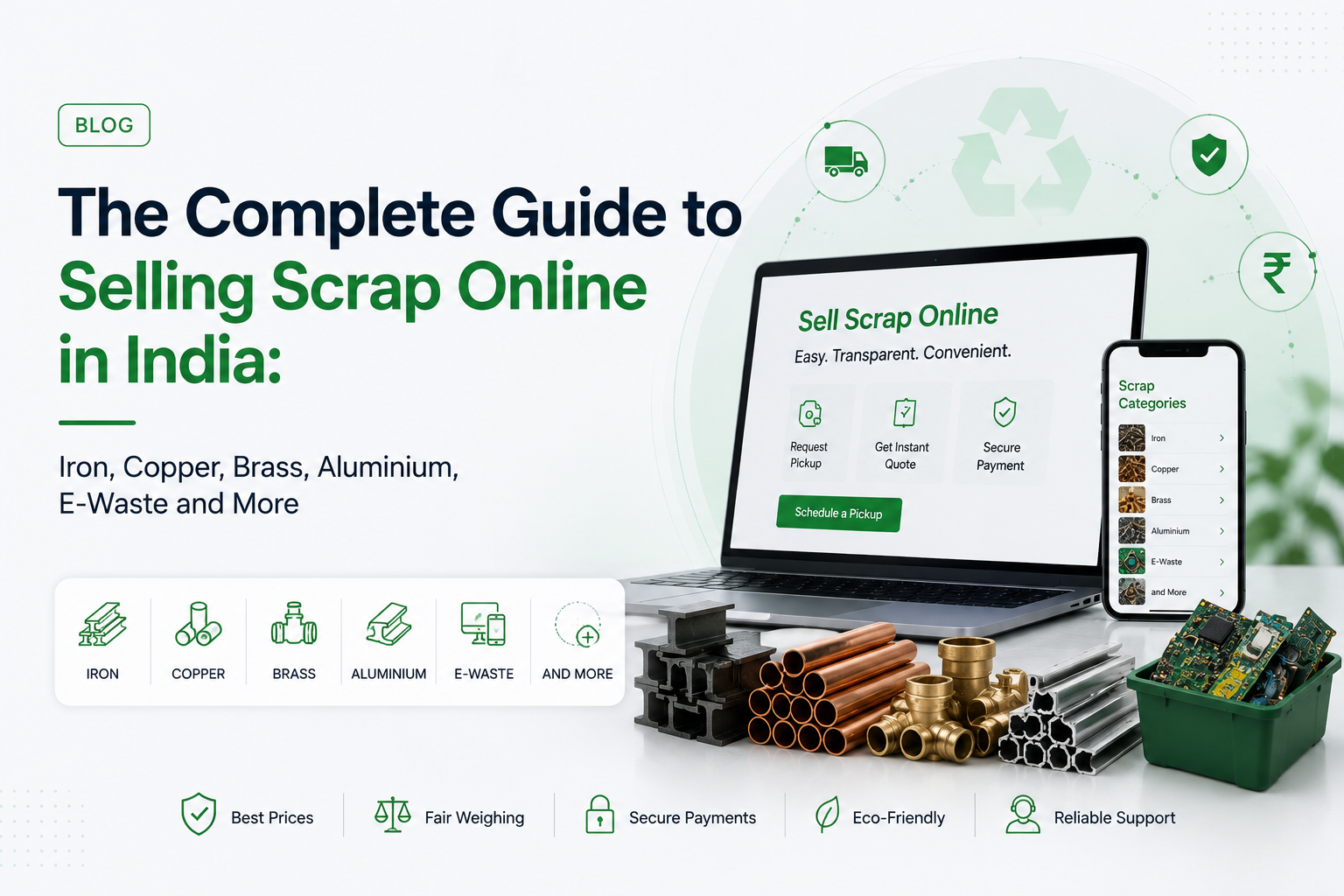
Selling scrap online in India means booking a doorstep scrap pickup through a digital platform, getting materials weighed transparently on-site, and receiving instant payment. Accepted categories include iron scrap, steel scrap, copper scrap, brass scrap, aluminium scrap, plastic scrap, newspaper scrap, cardboard, e-waste, and household appliances. Prices depend on material type, purity, quantity, and current commodity market rates.
Table of Contents
- What Is Scrap and Why Does It Have Value?
- Why Sell Scrap Online Instead of Through a Local Kabadiwala?
- Types of Scrap You Can Sell
- How Scrap Prices Are Determined
- How Doorstep Scrap Pickup Works
- Residential Scrap Collection
- Commercial and Office Scrap Collection
- Industrial and Factory Scrap Collection
- Benefits of Recycling Scrap
- How to Get the Best Scrap Value
- Frequently Asked Questions
- Conclusion
Introduction
Every home, office, shop, factory, and warehouse accumulates scrap over time. Old newspapers pile up in corners. Broken electronics gather dust in storage rooms. Unused iron grills and copper wires occupy space that could be put to better use. Discarded appliances sit in backyards long after they stop working.
Instead of letting these materials sit idle or end up in a landfill, they can be converted into cash while supporting responsible recycling. Selling scrap online has made this process faster, more transparent, and significantly more convenient than the traditional kabadiwala experience most Indian households grew up with.
This guide covers everything you need to know about selling scrap online in India. Whether you have a single stack of newspapers or a factory full of metal offcuts, the process is the same: book a pickup, get weighed transparently, receive instant payment, and let the materials move into the recycling chain rather than the waste stream.
What Is Scrap and Why Does It Have Value?
Quick Definition: Scrap refers to materials that have reached the end of their primary useful life but still retain significant economic value because they can be reprocessed into new products. Scrap is not waste. It is a raw material.
The most important thing most people do not realize about scrap is that it is genuinely valuable. A kilogram of copper wire sitting unused in a drawer is worth real money on the commodity market today. A stack of old newspapers weighing 10 kilograms generates more income from a professional scrap buyer than it ever would from a local street vendor.
Why Scrap Retains Value
When a metal item reaches the end of its life, the metal itself does not disappear. Iron is still iron. Copper is still copper. Aluminium is still aluminium. These materials can be melted down and reformed into new products with a fraction of the energy and cost required to mine and refine them from raw ore.
This is why manufacturers actively seek recycled materials. Steel plants buy iron scrap. Electrical manufacturers buy copper scrap. Construction companies buy recycled aluminium. The demand is real, constant, and tied directly to global commodity markets, which is why scrap prices move with metal exchange rates.
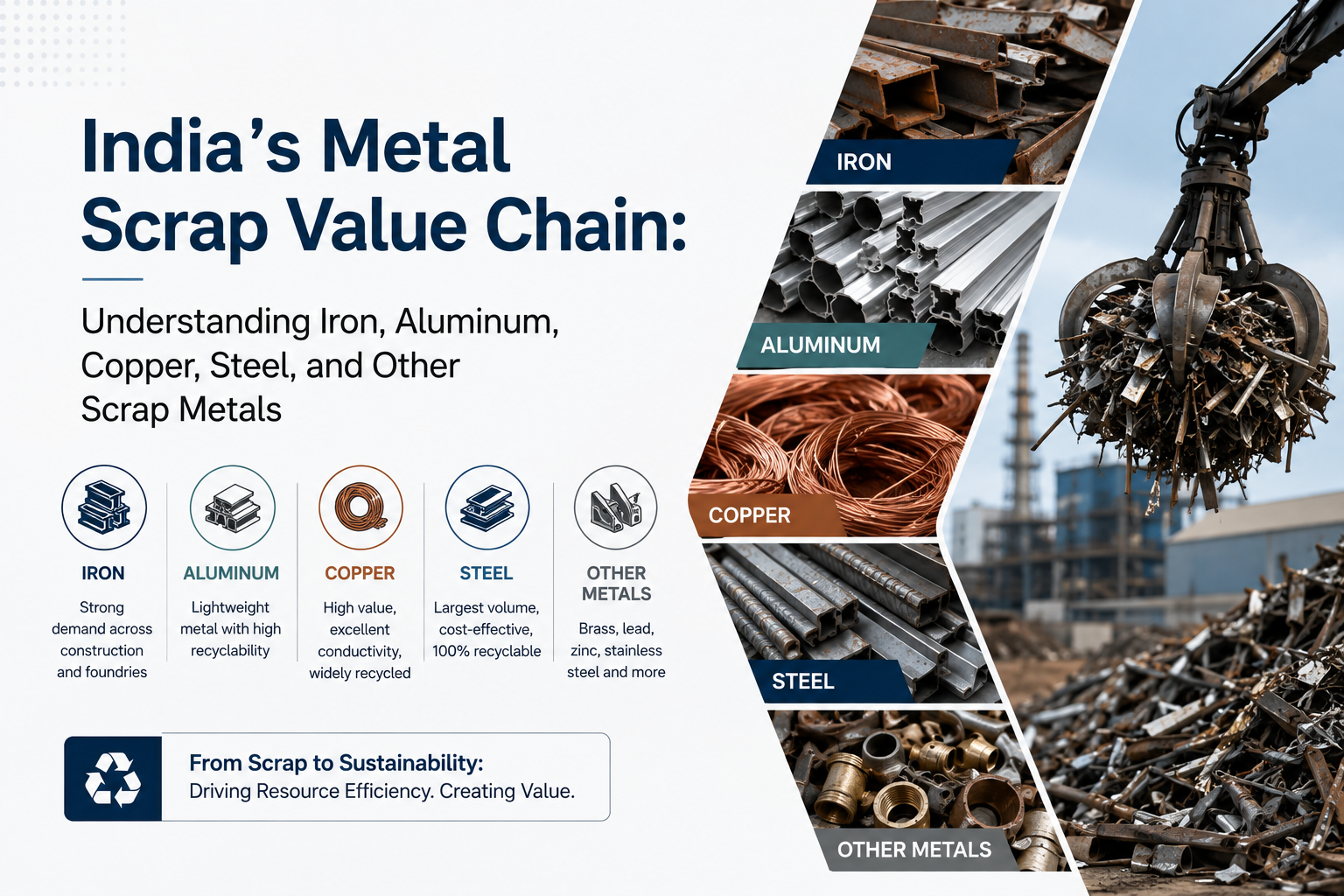
Common Scrap Categories Available in Indian Homes and Businesses
| Category | Common Examples | Typical Buyer |
|---|---|---|
| Iron Scrap | Rods, pipes, gates, grills, old furniture frames | Steel plants, foundries |
| Copper Scrap | Wires, cables, motors, AC components | Electrical manufacturers |
| Brass Scrap | Taps, valves, fittings, locks | Hardware and plumbing industries |
| Aluminium Scrap | Window frames, cookware, cans | Packaging and construction industries |
| Paper Scrap | Newspapers, cardboard, office paper | Paper mills |
| Plastic Scrap | PET bottles, HDPE containers, packaging | Plastic recyclers |
| E-Waste | Phones, laptops, computers, TVs | Authorized e-waste processors |
| Appliances | Refrigerators, washing machines, ACs | Dismantling and metal recovery units |
Key Takeaway: Scrap is not garbage. Every kilogram of iron, copper, brass, aluminium, paper, or plastic you hand over to a scrap buyer is a kilogram of raw material that re-enters the manufacturing economy rather than going to a landfill.
Why Sell Scrap Online Instead of Through a Local Kabadiwala?
Most people in India have sold scrap at some point through a local kabadiwala or scrap dealer who visits the neighborhood on a cycle or handcart. If you have ever searched for a kabadiwala near me or a scrap buyer near me and found the experience unreliable, you are not alone. The traditional model comes with well-known frustrations: inconsistent pricing that varies by mood rather than market, no weighing transparency, limited material acceptance, and no reliable schedule.
Online kabadiwala platforms and doorstep scrap collection services solve each of these problems systematically. Whether you want to sell scrap online in India, book a scrap pickup near me, or arrange doorstep scrap collection from your home or office, the process is now as simple as booking a cab.
What Online Scrap Pickup Offers That a Local Kabadiwala Often Cannot
Transparent digital weighing. A trained collection executive arrives with a calibrated digital weighing machine. Every kilogram is counted and shown to you on a display you can read directly.
Market-linked pricing. Online platforms update scrap rates based on current commodity market movements. You receive a price that reflects what the material is actually worth today, not what someone decides to offer you on the spot.
Scheduled appointments. You choose your pickup date and time window through an app or website. No waiting around for a kabadiwala to pass by, no chasing someone down the street.
Multiple material acceptance in one visit. A single pickup can cover newspaper scrap, iron scrap, copper wires, plastic bottles, and old appliances simultaneously, rather than needing separate buyers for each category.
Professional handling. Collection staff are trained to handle materials including e-waste safely, which matters for both personal safety and environmental compliance.
Instant or same-day payment. Payment is processed at the point of pickup via cash, UPI, or bank transfer, depending on the platform and amount.
Doorstep convenience. You do not need to carry anything to a collection point. The service comes to your address.
Comparison: Online Kabadiwala vs. Traditional Kabadiwala
| Factor | Online Kabadiwala | Traditional Kabadiwala |
|---|---|---|
| Pricing | Market-linked, updated daily | Variable, often below market |
| Weighing | Calibrated digital machine | Often manual, difficult to verify |
| Scheduling | App or online booking | Unpredictable availability |
| Material acceptance | Wide range including e-waste and dry waste collection | Usually limited to paper and basic metals |
| Payment | Instant digital or cash | Cash only, sometimes delayed |
| E-waste handling | Authorized recycling channels | Unregulated disposal risk |
| Commercial bookings | Available with bulk pricing | Rarely accommodated |
| Best kabadiwala access | Verified, rated professionals | Unknown reliability |
Key Takeaway: The core advantage of selling scrap online is not just convenience. It is the combination of transparent pricing, reliable scheduling, and responsible recycling in a single transaction. Finding the best kabadiwala is now a matter of choosing the right platform rather than waiting for the right person to pass your street.
Types of Scrap You Can Sell
Understanding what you have and what it is worth begins with knowing which material category it falls into. Here is a complete breakdown of every major scrap category accepted by professional online scrap buyers in India.
Iron Scrap
Iron is the most commonly recycled metal in India by volume. It forms the backbone of steel production and is in constant demand from foundries and steel mills. If you are looking for an iron scrap buyer or want to sell iron scrap online, this is the largest-volume category available in most Indian homes and construction sites.
What counts as iron scrap: Iron rods and rebars from construction projects, old iron pipes, iron gates and window grills, iron nails and bolts, machinery parts and frames, structural steel beams, old iron furniture, vehicle chassis components, and fabrication offcuts from workshops.
Why it has value: Iron can be recycled repeatedly without losing its structural properties. Every tonne of recycled iron saves approximately 1.4 tonnes of iron ore and 740 kilograms of coal from being mined.
Typical price range: Iron scrap prices in India generally range from ₹25 to ₹40 per kilogram depending on grade, purity, and current steel market rates.
Steel Scrap
Steel scrap overlaps with iron scrap in many cases but commands different pricing based on alloy content and form. A steel scrap buyer evaluates stainless content, alloy grade, and contamination level before pricing.
What counts as steel scrap: Stainless steel utensils and kitchen equipment, steel office and home furniture, industrial steel shelving and racks, steel sheets and plates, structural steel sections, steel pipes and tubing, and railway equipment components.
Why it has value: Recycled steel is used extensively in automobiles, construction, railways, and manufacturing. India is among the world’s largest steel producers and a major consumer of scrap steel as a feedstock.
Copper Scrap
Copper is one of the highest-value recyclable metals available in Indian homes and businesses. A copper scrap buyer pays premium rates because copper retains its conductivity and structural properties through repeated recycling.
What counts as copper scrap: Electrical wiring and cables from renovation projects, copper pipes from plumbing work, motor windings from old appliances, transformer coils, air conditioner coils and tubing, electrical fittings and connectors, and heat exchangers.
Why it has value: Copper retains 90 percent of its original value after recycling and can be reprocessed indefinitely without quality loss. Global copper demand from electronics, electric vehicles, and renewable energy infrastructure keeps prices consistently high.
Typical price range: Copper scrap in India typically fetches ₹450 to ₹700 per kilogram depending on grade. Bright bare copper wire commands the highest rates. Mixed or insulated copper wire is priced lower.
Brass Scrap
Brass is an alloy of copper and zinc, giving it significant value as a recyclable material. A brass scrap buyer assesses copper content and contamination before pricing. It is commonly found in older homes during renovation and in industrial settings.
What counts as brass scrap: Brass water taps and faucets, plumbing valves and pipe fittings, door handles and locks, decorative items and sculptures, hardware components, bullet casings, musical instruments, and industrial bushings and bearings.
Why it has value: The copper content in brass makes it a premium recycling material. Brass foundries and plumbing hardware manufacturers are consistent buyers of good-quality brass scrap.
Typical price range: Brass scrap in India generally ranges from ₹300 to ₹500 per kilogram depending on copper content and contamination level.
Aluminium Scrap
Aluminium is lightweight, corrosion-resistant, and among the most energy-efficient materials to recycle. An aluminium scrap buyer looks for form, alloy grade, and contamination level. Producing new aluminium from recycled material uses 95 percent less energy than smelting from bauxite ore.
What counts as aluminium scrap: Window and door frames from renovation projects, aluminium ladders, kitchen utensils and cookware, aluminium sheets and foil rolls, beverage cans, automobile parts, and electrical conductor cables.
Why it has value: Aluminium’s energy efficiency makes recycled aluminium extremely attractive to manufacturers. The packaging, construction, and automotive industries are the primary buyers.
Typical price range: Aluminium scrap in India typically fetches ₹80 to ₹140 per kilogram depending on form and alloy grade.
Plastic Scrap
Plastic recycling prevents one of the most persistent environmental problems facing Indian cities: plastic accumulation in drainage systems, water bodies, and open dumps. A plastic scrap buyer accepts sorted, clean plastics at the best rates.
What counts as plastic scrap: PET water and beverage bottles, HDPE containers and cans, plastic chairs and furniture, buckets and storage containers, packaging materials, and rigid industrial plastic components.
Important note: Mixed or contaminated plastics are harder to recycle and generally command lower prices. Clean, sorted plastics by type fetch better rates from recyclers.
Typical price range: Plastic scrap rates in India vary widely by type. PET bottles generally fetch ₹8 to ₹15 per kilogram. HDPE commands slightly higher rates. Mixed plastic is priced lower.
Newspaper and Paper Scrap
Paper recycling is the most accessible recycling activity for Indian households and offices. Whether you are an old newspaper buyer looking to sell or a household clearing out years of accumulated print, paper fibers can typically be recycled 5 to 7 times before they become too short for further use. A newspaper scrap buyer or cardboard scrap buyer prices materials separately, so keeping them sorted improves your return.
What counts as paper scrap: Daily newspapers and magazines, office paper and printouts, books and notebooks, cardboard boxes and packaging cartons, brown paper bags, and corrugated sheets.
Sorting tip: Keeping newspapers separate from cardboard and office paper typically improves pricing, as paper mills prefer sorted feedstock.
Typical price range: Newspaper scrap price in India generally ranges from ₹10 to ₹18 per kilogram. Cardboard rates vary between ₹6 and ₹12 per kilogram depending on quality and moisture content.
Electronic Waste (E-Waste)
E-waste is the fastest-growing waste category in India and globally. E-waste collection and electronic waste recycling through authorized channels ensures hazardous materials are handled safely while recovering valuable metals. It contains both hazardous materials that require careful handling and valuable metals that make proper recycling economically worthwhile.
What counts as e-waste: Desktop computers and computer scrap, laptop scrap, monitors, mobile phones and tablets, keyboards, mice, and peripherals, printers and scanners, routers and networking equipment, televisions, servers and data center hardware, and small electronic accessories. An e-waste pickup covers all of these in a single visit. A computer scrap buyer assesses age, working condition, and component content before pricing.
Why authorized e-waste recycling matters: Electronics contain lead, mercury, cadmium, and other hazardous materials that can leach into soil and groundwater if improperly disposed of. Authorized recyclers are equipped to handle these safely while recovering gold, silver, copper, and rare earth elements from circuit boards.
Pricing for e-waste: E-waste pricing depends heavily on the age, condition, and type of device. Functional items may be assessed for refurbishment value. Non-functional items are priced by weight and component content.
Household Appliances
Large appliances contain a mix of recyclable materials including steel, copper, aluminium, plastics, and compressor components. Whether you need an AC scrap buyer, a refrigerator scrap buyer, a washing machine scrap buyer, or a laptop scrap buyer, a professional online platform handles all of these in a single scheduled pickup. Professional scrap buyers are equipped to handle and transport these safely.
Common appliances accepted: Refrigerators and deep freezers, washing machines and dryers, window and split air conditioners, microwave ovens, water coolers and dispensers, ceiling and table fans, electric water heaters, mixers and grinders, and dishwashers.
What makes appliances valuable: A single old refrigerator contains steel for its body, copper in its motor windings, aluminium in its condenser coils, and refrigerant in its compressor, all of which have separate recycling value streams.
Key Takeaway: The categories with the highest per-kilogram value in most Indian homes are copper scrap, brass scrap, and functioning electronics. Iron, steel, and paper generate lower per-kilogram returns but often make up the bulk of available scrap by weight.
How Scrap Prices Are Determined
One of the most common questions people ask before selling scrap is why prices change, and why the rate they were quoted last month is different from what they receive today.
The Factors That Move Scrap Prices
Global commodity market rates. Copper, aluminium, iron, and brass prices are all traded on international commodity exchanges. When global demand for copper rises, scrap copper prices in India rise with it. When iron ore prices fall, iron scrap prices typically follow. Scrap is not priced in isolation from global markets.
Material purity and grade. A kilogram of clean, bare copper wire is worth significantly more than a kilogram of insulated copper wire because stripping and processing costs reduce the effective metal content. Similarly, mixed iron containing rubber, paint, or other contaminants fetches less than clean iron scrap. Separating and cleaning materials before a pickup directly improves the rate you receive.
Quantity. Bulk quantities almost always command better rates than small quantities because they reduce the cost per kilogram for the buyer. A factory selling five tonnes of copper scrap will receive a better rate per kilogram than a household selling five kilograms.
Local supply and demand. Regional factors matter. Cities with higher concentrations of manufacturing plants that consume recycled metals tend to support stronger local scrap prices because the transportation cost from collection point to processing facility is lower.
Seasonal demand patterns. Construction activity peaks in certain seasons, driving higher demand for iron and steel scrap. Monsoon slowdowns in construction can soften iron scrap rates temporarily. Being aware of these patterns helps sellers decide when bulk selling makes sense.
Transportation and logistics costs. These are factored into the rate offered by any scrap buyer. Services offering doorstep pickup absorb transportation costs into their pricing model, which is why rates may differ slightly from buyer to buyer.
Why Scrap Rates Change Daily
Scrap buyers adjust rates daily or weekly in response to movements in the London Metal Exchange (LME), Multi Commodity Exchange (MCX) India, and local dealer pricing. Platforms that publish a live scrap rate today page are giving you the closest approximation to what you should expect for that day’s pickup. You can check the current iron scrap price, copper scrap rate, and newspaper scrap price on the platform’s rates page before confirming your booking.
Key Takeaway: The single most reliable way to maximize scrap value is to sort materials by category before pickup. Clean, separated scrap always fetches more than mixed, contaminated scrap.
How Doorstep Scrap Pickup Works — How to Sell Scrap Online
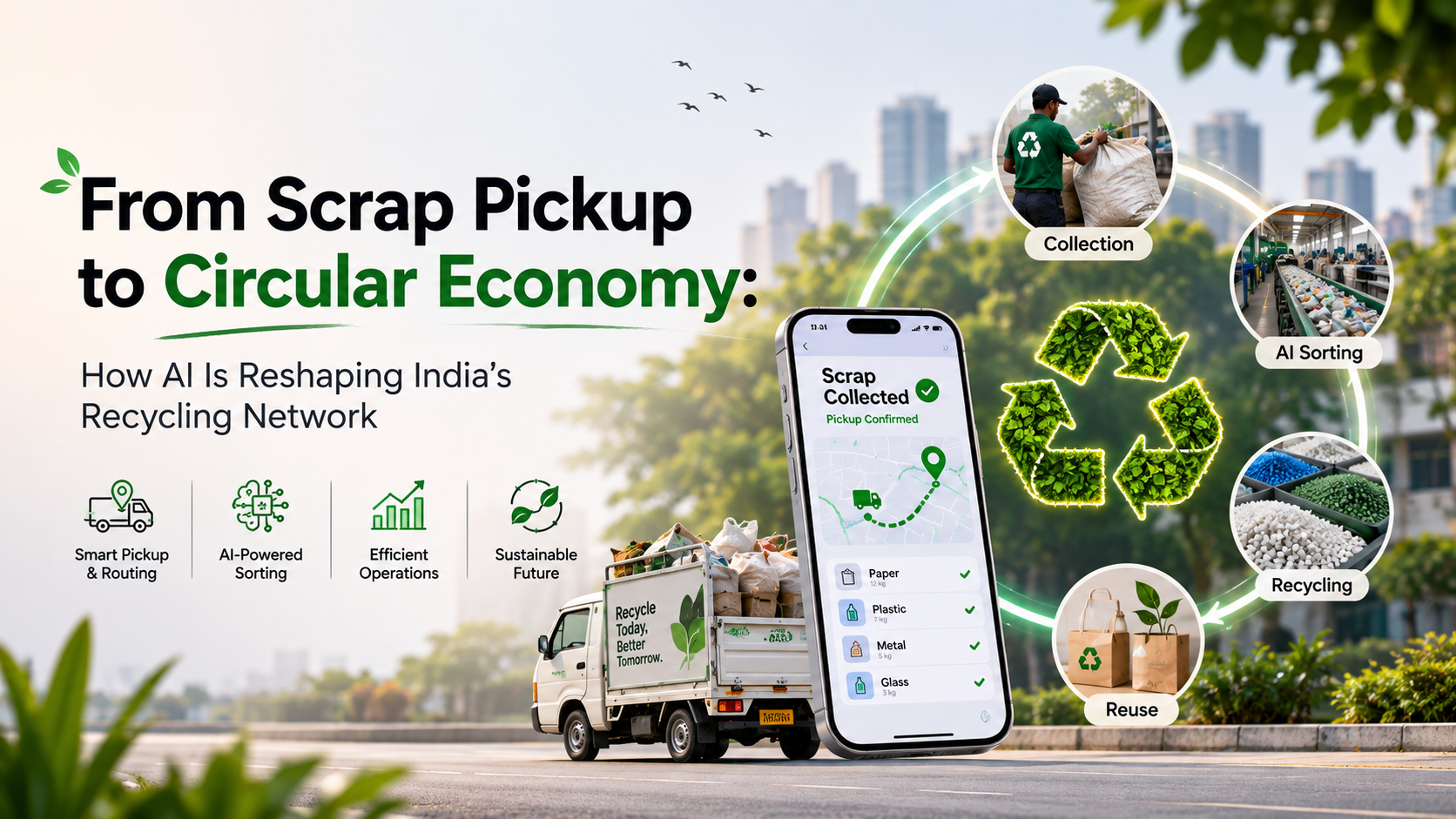
The entire process from booking to payment typically takes less than an hour at your location. Here is exactly what to expect when you sell scrap online through a doorstep pickup platform.
Step 1: Book Your Pickup
Open the platform’s website or app. Select your material categories, enter your address, and choose a pickup date and time slot that works for you. Most platforms offer same-day or next-day availability in major cities.
Step 2: Receive Confirmation
You receive a booking confirmation with the name and contact number of your assigned collection executive, along with the scheduled time window.
Step 3: The Collection Executive Arrives
A trained staff member arrives at your address within the scheduled window. They bring a calibrated digital weighing machine, collection bags, and the necessary equipment to safely handle appliances and e-waste.
Step 4: Materials Are Sorted and Weighed
Each category of material is weighed separately on the digital scale. The weight reading is visible to you throughout the process. This is the transparency step that eliminates the guesswork and negotiation typical of informal scrap transactions.
Step 5: Price Is Calculated Transparently
The executive applies the current day’s rate for each material category to the recorded weights. You can see the calculation. There are no hidden deductions or last-minute price changes.
Step 6: You Receive Instant Payment
Payment is made at the point of pickup via cash, UPI transfer, or bank transfer depending on the platform and the amount. For larger commercial transactions, payment terms may be agreed in advance.
Step 7: Scrap Is Transported for Responsible Recycling
Your materials are loaded and transported to authorized collection and recycling facilities. E-waste goes to certified e-waste processors. Metals go to authorized dealers and eventually to manufacturers.
Key Takeaway: The entire pickup process is designed to be transparent at every step: weight, rate, and payment are all visible and confirmed before the collection executive leaves your premises.
Residential Scrap Collection
Households are among the most consistent sources of recyclable materials in India. The average urban Indian home generates meaningful quantities of scrap across multiple categories every year, most of which currently sits unused in storage rooms, garages, and balconies.
What Households Typically Have to Sell
Paper and cardboard. Accumulated newspapers, old magazines, cardboard boxes from e-commerce deliveries, and office paper are among the easiest materials to collect and sell. Most families have at least 10 to 20 kilograms of paper scrap available at any given time.
Old appliances. A broken or obsolete refrigerator, washing machine, or air conditioner typically contains several kilograms of recoverable metal and components. These items are bulky to store and genuinely valuable to recycle.
Kitchen and household metals. Old aluminium utensils, stainless steel items that have been replaced, and copper-bottomed cookware all have scrap value. Renovation and remodeling projects typically generate the most metal scrap in a residential setting.
Electronics. Older phones, laptops, desktop computers, and peripherals that are no longer in use are a source of e-waste recycling value. Even non-functional devices have component and metal value.
Iron and steel items. Old iron gates, broken metal furniture, iron rods left over from construction, and steel shelves that have been replaced all qualify as iron or steel scrap.
How Apartments and Housing Societies Can Maximize Scrap Value
Individual apartments selling small quantities receive fair market rates, but housing societies that organize collective pickups can negotiate better terms due to volume. Apartment scrap collection and society scrap pickup drives, where materials from multiple flats are consolidated into a single bulk booking, consistently deliver better per-kilogram rates for all participants and reduce the number of visits required.
Many platforms offer dedicated programs for apartment complexes and residential societies, including recurring pickup schedules and reporting on recycled quantities for sustainability documentation. A professional scrap recycling company can also provide a scrap collection app that lets residents book pickups individually while the platform coordinates consolidated collection from the building.
Commercial and Office Scrap Collection
Offices, retail businesses, hotels, schools, hospitals, and other commercial establishments generate scrap at a scale that individual households do not. Corporate scrap management and office e-waste disposal require a more structured approach than a one-off residential pickup. A professional waste management company that specializes in scrap collection handles everything from scheduling to recycling compliance documentation.
Common Commercial Scrap Categories
Office e-waste. IT equipment cycles through offices quickly. Computers, monitors, laptops, printers, servers, routers, and telecommunication equipment that are past their useful life constitute a significant e-waste stream. Proper disposal through authorized channels is not just good practice but increasingly a compliance requirement for businesses.
Office furniture and fittings. Steel desks, aluminium partitions, iron shelving units, and metal filing cabinets from office refurbishments all have scrap value. What looks like disposal cost can often be converted into partial recovery through scrap.
Paper and cardboard. High paper consumption is characteristic of most offices. Daily shredding, document disposal, packaging from deliveries, and archiving purges all generate paper scrap volumes that can be collected on a regular schedule.
Electrical and wiring materials. Office renovations, branch openings, and infrastructure upgrades leave behind copper wiring, aluminium conduits, and electrical fittings that have significant scrap value.
How Recurring Commercial Pickups Work
Commercial clients typically set up a recurring collection schedule rather than booking individual pickups. A weekly or monthly collection appointment is agreed upon, with collection staff arriving on a fixed day to weigh, price, and remove accumulated materials. This keeps the workplace organized and converts what would otherwise be a waste management cost into a recovery stream.
Industrial and Factory Scrap Collection
Manufacturing plants, fabrication workshops, construction companies, and warehouses generate scrap in quantities that require dedicated management rather than ad-hoc selling. An industrial scrap buyer who serves B2B clients offers bulk pricing agreements, dedicated collection vehicles, and recycling certificates that support environmental compliance documentation.
Industrial Scrap Categories
Metal fabrication offcuts. Every cutting, machining, and forming operation in a metal workshop produces offcuts and trimmings that are pure, high-quality scrap. Iron, steel, copper, brass, and aluminium offcuts from fabrication are among the cleanest and most valuable scrap categories available.
Machinery and equipment. Obsolete machinery, broken equipment, and decommissioned plant assets contain large quantities of recoverable metal. A single retired industrial machine can yield hundreds of kilograms of iron, steel, copper, and aluminium scrap.
Packaging waste. Industrial operations consume large volumes of cardboard, wooden pallets, and plastic wrapping. Cardboard and plastic scrap from these sources can be collected in bulk at regular intervals.
Construction waste. Building and infrastructure projects generate iron rebars, structural steel sections, aluminium formwork, copper wiring, and PVC piping, all of which have scrap value when projects are completed or phased.
Managing Industrial Scrap Efficiently
Factories benefit from a structured scrap management plan that includes designated scrap collection areas within the facility, regular collection intervals tied to production cycles, separation of materials by type at source, and documentation for recycling compliance and sustainability reporting.
Professional scrap buyers who serve industrial clients typically offer bulk pricing agreements, dedicated collection vehicles for large quantities, and recycling certificates that support environmental compliance documentation.
Benefits of Recycling Scrap
Selling scrap generates income, but the broader benefits of responsible scrap recycling extend well beyond the payment received at pickup.
Environmental Benefits
Natural resource conservation. Every kilogram of recycled iron replaces a kilogram of iron ore that would otherwise need to be mined. Recycling one tonne of aluminium saves up to eight tonnes of bauxite. These are material reductions in mining pressure on the natural environment.
Energy savings. Producing metals from recycled scrap uses dramatically less energy than producing from raw ore. Recycled aluminium requires 95 percent less energy than primary production. Recycled steel requires 60 to 70 percent less energy. These energy savings translate directly into reduced carbon emissions.
Reduced landfill burden. Electronic waste, plastics, and non-biodegradable materials that are properly recycled do not end up in landfills. India’s landfills are under severe pressure in most major cities. Every kilogram diverted through recycling extends the functional life of existing waste infrastructure.
Lower greenhouse gas emissions. The mining, processing, and manufacturing chain for new metals is one of the most carbon-intensive industrial activities. Substituting recycled materials at any point in that chain reduces cumulative emissions.
Economic Benefits
Income generation for sellers. The most immediate economic benefit is the money received for scrap. For households, this might be a modest but welcome supplement. For commercial and industrial operations, it is a measurable line item that offsets waste disposal costs.
Support for domestic manufacturing. Indian steel, copper, aluminium, and paper manufacturers depend on domestic scrap supply as a raw material feedstock. A robust scrap recycling sector keeps this supply chain strong and reduces dependence on imported raw materials.
Employment creation. The scrap and recycling sector is a significant employer across collection, processing, and manufacturing activities in India. Supporting organized scrap recycling strengthens this employment base.
Social Benefits
Cleaner urban environments. Scrap that is properly collected does not pile up in streets, drains, or open spaces. Regular scrap collection in residential and commercial areas contributes directly to cleaner neighborhoods.
Reduced informal recycling risks. Unregulated scrap handling, particularly of e-waste, exposes informal workers to toxic materials. Organized, authorized collection channels reduce the volume of material handled outside safety protocols.
How to Get the Best Scrap Value
The rate you receive for scrap is influenced by factors within your control. These practices consistently improve returns.
Separate Materials by Category
Mixed scrap is always valued at the lowest common denominator in the mix. Copper wire bundled with iron scrap is priced as mixed scrap, not as copper. Keeping categories separate takes minimal effort and can meaningfully improve your total payment.
Clean Your Materials
Removing non-metal components from metal scrap improves purity and rate. Stripping rubber insulation from copper wire, removing plastic parts from aluminium items, and cleaning oil or grease from metal surfaces all improve what a buyer is willing to pay.
Keep Paper and Cardboard Dry
Wet newspaper and cardboard is priced lower because moisture adds weight without adding recyclable fiber value. Store paper scrap in a dry location and avoid leaving it where it can absorb rain or humidity before pickup.
Bundle Cardboard and Newspapers
Loose, scattered paper takes longer to handle and load. Bundled and tied scrap is easier for collection staff and signals that material has been prepared thoughtfully.
Schedule Bulk Pickups When Possible
Accumulating more material before booking a pickup generally improves the rate you receive. Small quantities of 2 to 3 kilograms across a few categories may not meet the pricing threshold for premium rates. Building up to a meaningful quantity before scheduling is worth the wait if storage permits.
Check Current Market Rates Before Booking
Most professional platforms publish today’s scrap rates on their website. Checking these before booking confirms your expectations and allows you to compare across services if you are evaluating options.
Ask About Society or Community Rates
If you live in an apartment complex or are coordinating a pickup for a commercial property, ask about bulk or society rates. Volume pricing is commonly available and not always advertised.
Frequently Asked Questions
General Questions
What is a kabadiwala? A kabadiwala is a scrap collector or buyer in India. The term covers both traditional door-to-door scrap collectors who travel by cycle or handcart and modern online platforms that offer scheduled doorstep pickup with digital weighing and transparent pricing.
What is the difference between scrap and waste? Scrap has residual economic value and can be reprocessed into new products. Waste, in the true sense, has no further use. Iron scrap, copper wire, old newspapers, and plastic bottles are all scrap, not waste, because they are valuable raw materials for manufacturing.
How to sell scrap online? How to sell scrap online is a three-step process: visit the platform’s website or scrap collection app, choose your material categories and enter your address, then pick a pickup slot. A collection executive arrives, weighs your scrap with a digital machine, pays you on the spot, and takes the materials for recycling. No transport, no negotiation, no waiting.
Is selling scrap legal in India? Yes. Selling scrap materials is entirely legal. Proper disposal of e-waste through authorized recyclers is encouraged and increasingly mandated by India’s e-waste management rules. Selling through organized platforms ensures compliance with applicable regulations.
Can I sell both residential and commercial scrap to the same platform? Yes. Most professional online scrap buyers serve both residential and commercial customers. Commercial customers typically have access to dedicated account management and volume pricing.
Is there a scrap buyer in Ahmedabad? Yes. Ahmedabad is one of the most active scrap collection markets in India. A scrap buyer Ahmedabad operating through an online platform offers doorstep pickup across major areas of the city including Satellite, SG Highway, Bopal, Maninagar, Navrangpura, and Chandkheda. If you want to sell scrap online India wide, the same platform covers multiple cities with the same transparent pricing model.
Scrap Pricing Questions
Why did my scrap rate change from last week? Scrap rates are linked to global commodity markets. When the price of copper, iron, or aluminium moves on international exchanges, local scrap rates adjust accordingly. Rates can change daily for premium metals like copper and brass.
Which scrap category has the highest value? Copper scrap typically commands the highest per-kilogram price in India, followed by brass scrap and aluminium scrap. Iron and steel scrap are lower per kilogram but often available in larger quantities that make the total value significant.
How can I find out today’s scrap rate? Check the live rates page on the platform’s website before booking. Rates are updated regularly based on current market conditions.
Does the quantity I have affect the rate? Yes. Larger quantities generally attract better rates because they reduce handling cost per kilogram for the buyer. Communicating your approximate quantity when booking a pickup helps ensure you receive appropriate pricing.
Pickup Process Questions
How do I book a scrap pickup? Visit the platform’s website or app, select your material categories and approximate quantities, enter your address and preferred pickup time, and confirm your booking. You will receive a confirmation with your collection executive’s details.
Is there a minimum quantity required? Minimum quantity requirements vary by platform and location. Most residential pickups are accommodated with a minimum of 5 to 10 kilograms of total material. Commercial and industrial pickups typically have higher minimums. Contact the platform to confirm requirements for your area.
Do I need to carry scrap anywhere? No. Doorstep pickup means the collection executive comes to your address. You do not need to transport materials to any collection point.
How is scrap weighed? A calibrated digital weighing machine is brought by the collection executive. All weighing is done at your premises, in front of you, with the digital reading visible at all times.
What payment methods are accepted? Most platforms offer cash payment at the time of pickup. UPI transfer and bank transfer are typically available for larger amounts. Payment is made before the collection executive leaves your premises.
Can I schedule a recurring pickup? Yes. Commercial customers, housing societies, and businesses can arrange weekly or monthly recurring collection schedules. This is the most efficient model for operations that generate scrap continuously.
Material-Specific Questions
Can I sell mixed scrap in one pickup? Yes. A single pickup can cover multiple material categories. Iron scrap, copper wire, old newspapers, plastic bottles, and an old appliance can all be collected in one visit, weighed separately by category, and priced accordingly.
Do you buy non-working appliances? Yes. Non-functional appliances have scrap value in the metals and components they contain even when they no longer work. Refrigerators, washing machines, and air conditioners are accepted regardless of working condition.
What condition does e-waste need to be in? E-waste is accepted in any condition: working, non-working, broken, or incomplete. The scrap value of electronics comes from their component metals and recyclable materials, not their functional status.
Can I sell just one or two items? Yes, though small quantities may not meet the threshold for premium rate tiers. If you have only a single item like one old laptop or a small amount of newspaper, you can still book a pickup, but consolidating with other household scrap before scheduling will generally improve your overall return.
Is copper wire valued the same whether insulated or bare? No. Bare copper wire with no insulation commands a significantly higher rate because there is no processing required to access the metal. Insulated wire is priced lower to account for the stripping cost the buyer must absorb. If you are able to strip insulation before pickup, it will improve your rate.
Do you accept batteries? Yes. Battery recycling is an important part of responsible scrap management. Old vehicle batteries, UPS batteries, and inverter batteries are accepted. These contain lead, which has scrap value, along with other recoverable materials. Safe disposal of batteries through authorized channels is important because of their hazardous content.
E-Waste Specific Questions
What is the e-waste recycling process? The e-waste recycling process involves collection through an authorized platform, transport to a certified facility, manual or automated dismantling to separate components, safe isolation of hazardous materials like lead and mercury, and recovery of valuable metals including gold, silver, copper, and palladium from circuit boards. Each step is governed by India’s e-waste management rules.
What happens to my e-waste after pickup? E-waste collected through authorized platforms is transported to certified e-waste processing facilities where hazardous materials are safely isolated and valuable metals including gold, silver, copper, and palladium are recovered through controlled processes.
Is my data safe when I sell a laptop or phone? You are responsible for wiping personal data from any device before handing it over for recycling. Factory resetting a phone or using a data-wiping tool on a laptop before pickup is strongly recommended. Professional scrap buyers do not take responsibility for data on devices after collection.
Why is e-waste recycling important? Electronics contain hazardous materials including lead, mercury, cadmium, and flame retardants that can contaminate soil and groundwater if improperly disposed of. Authorized recycling ensures these materials are handled safely while recovering valuable metals that would otherwise be lost.
Conclusion: Turning Scrap Into Value {#conclusion}
Every home in India has scrap. The iron grill that was replaced during renovation, the newspapers stacked in the store room, the old laptop sitting in a drawer, the aluminium utensils that have been replaced with new ones. These materials have real, quantifiable value in today’s commodity markets.
Selling scrap online is now the most transparent, convenient, and responsible way to convert that value into income. A scheduled doorstep pickup with digital weighing, market-linked pricing, and instant payment removes every friction point that made traditional scrap selling unreliable.
The environmental case is equally strong. Every kilogram of iron, copper, brass, aluminium, plastic, and paper that moves through a proper recycling channel represents a measurable reduction in mining, energy consumption, and landfill pressure.
The process is simple. Book a pickup, get weighed fairly, receive payment, and let the materials re-enter the manufacturing economy rather than sit in storage or end up in a dump.