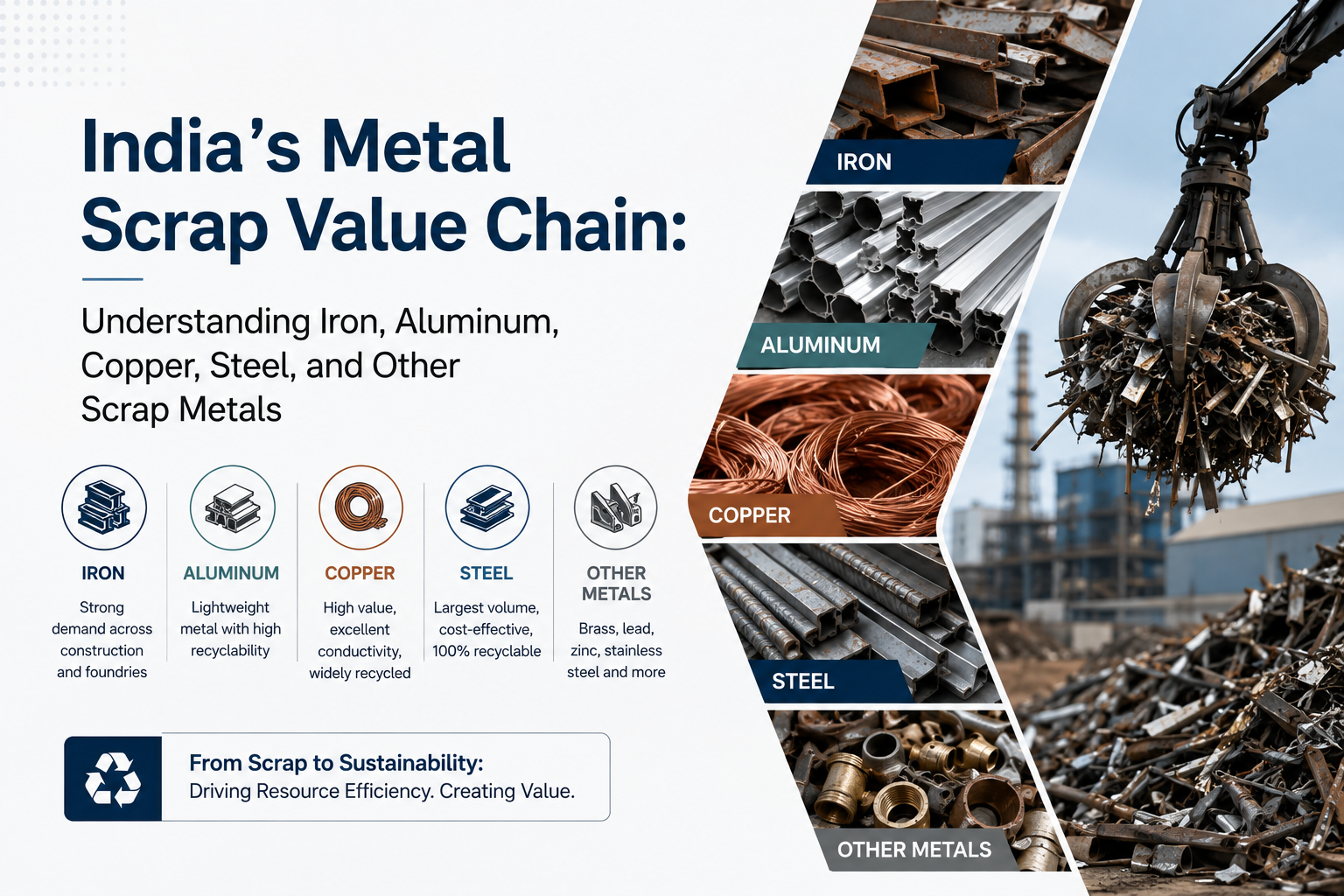
India’s metal scrap business and recycling industry are undergoing a massive transformation, shifting from a fragmented, informal trade network into a structured, multi-billion-dollar strategic industry. Driven by aggressive domestic infrastructure demands, global decarbonization pressures, and government-backed circularity pushes, scrap has transitioned from “waste” to a critical raw material.
India’s steel scrap consumption has increased significantly in recent years, supported by infrastructure development, automotive manufacturing, urbanization, and the expansion of scrap-based steelmaking. Official Ministry of Steel data shows domestic steel scrap consumption rising from around 25.6 million tons in FY2019 to more than 33 million tonnes in FY2024. Demand is expected to remain strong as India expands electric arc furnace (EAF) and other scrap-based steelmaking capacity.
Structural Breakdown of the Value Chain
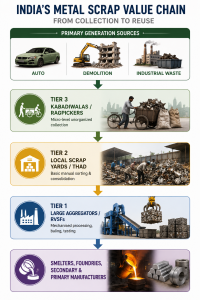
Generation Sources: Segmented into Obsolete Scrap (end-of-life vehicles, demolished buildings, old appliances) and Prompt Scrap (industrial trimmings, factory off-cuts, manufacturing waste).
Collection & Consolidation: Ground-level sorting begins with informal kabadiwalas and micro-aggregators who gather mixed materials from households, construction sites, and manufacturing units.
Processing & Value Addition: Larger scrap yards utilize mechanical baling, shredding, and shearing to achieve high density and remove contaminants. Advanced facilities apply sensor-based and magnetic sorting.
Melting & Refinement: Pure, dense metal fractions are distributed directly to secondary smelting units, induction furnaces, and electric arc furnaces (EAFs) to replace virgin ore.
Deep Dive by Key Metal Segment
1. Steel & Iron Scrap: Steel Recycling in India
Market Share & Scale: Ferrous scrap forms the bedrock of the entire recycling industry, anchoring over 70% of domestic market volume.
Key Industrial Drivers: Steel recycling in India is becoming increasingly important as steelmakers expand scrap-based production and invest in electric arc furnace (EAF) capacity. Compared with primary steelmaking routes, using one tonne of steel scrap can save approximately 1.1 tonnes of iron ore and significantly reduce energy use and greenhouse-gas emissions, although the exact savings vary by production technology and operating conditions.
Primary Sourcing: Heavily dominated by ship-breaking activities (such as Alang in Gujarat), structural building demolitions, and heavy infrastructure upgrades. End-of-life vehicles could generate around 10 million tonnes of steel scrap alone by 2025.
Steel Scrap Price in India: Indicative July 2026 rates for iron and steel scrap include HMS 1 (80:20) at ₹34.5–₹37.5/kg, HMS 2 at ₹32.5–₹35/kg, rolling scrap at ₹35.5–₹38.5/kg, shredded scrap at ₹37–₹41/kg, and cast iron scrap at ₹30–₹34/kg. These iron scrap prices in India are indicative and can vary by city, scrap grade, quantity, and transaction terms.
Regional Availability (2024–2026 Estimates):
Metal Scrap Prices in India
Metal scrap prices in India vary by metal type, grade, purity, location, quantity, and prevailing domestic and international market conditions. Ferrous scrap is generally priced differently from higher-value non-ferrous metals such as copper, aluminum, brass, and stainless steel.
For businesses, recyclers, and scrap traders, quoted prices should be evaluated alongside transportation, sorting, processing, testing, taxes, and applicable compliance costs rather than relying on a single national benchmark.
Common Scrap Price Factors
-
Metal grade and purity: Cleaner, higher-grade material generally commands better prices.
-
Quantity: Bulk commercial volumes may receive different pricing from small-lot transactions.
-
Location: Prices can vary between major recycling hubs and smaller local markets.
-
Processing level: Sorted, baled, shredded, or tested material can command a premium over mixed scrap.
-
Market conditions: Domestic demand, global commodity prices, and LME-linked movements can influence non-ferrous scrap values.
Indicative Scrap Metal Prices in India (2026):
| Material | Price Range (₹/kg) | Notes |
|---|---|---|
| Steel Scrap (HMS 1/2) | ₹32–₹38 | Ex-yard, excludes GST |
| Aluminum (Casting/Extrusion) | ₹80–₹140 | Varies by purity |
| Copper (Bright Wire) | ₹500–₹700 | High-grade, LME-linked |
| Brass | ₹300–₹450 | Plumbing/marine hardware |
| Stainless Steel (SS 304) | ₹55–₹70 | Kitchen/chemical scrap |
Because scrap metal rates in India can change with local demand and international commodity markets, businesses should verify current rates before finalizing large-volume purchases or sales.
Structural Challenges Hindering the Value Chain
While highly profitable, India’s scrap metal ecosystem faces deep systemic hurdles:
| Challenge | Impact on Value Chain |
|---|---|
| High Informality | Over 70% of local gathering is unorganized, leading to unstable supply volumes and non-transparent pricing. |
| Purity & Sorting Deficits | Manual sorting often leaves tramp elements (like copper mixed into steel scrap), reducing furnace yields. |
| Strict Import Constraints | Import and export opportunities depend on the applicable customs duties, scrap classification, quality requirements, hazardous-material controls, and prevailing government regulations. |
| Infrastructure Gaps | Limited mechanised dismantling and processing capacity outside major clusters (Gujarat, Maharashtra, Tamil Nadu). |
Regulatory Catalysts Transforming the Industry
Vehicle Scrappage Policy & RVSFs
India’s vehicle scrappage framework is supporting the development of Registered Vehicle Scrapping Facilities (RVSFs) for the formal collection, depollution, dismantling, and recycling of end-of-life vehicles. The growing RVSF network is helping shift vehicle recycling toward more organized and traceable processing.
BIS Standardization
The Bureau of Indian Standards (BIS) is progressively enforcing strict code definitions on scrap grades. This protects domestic furnaces from poor-quality, contaminated inputs.
Digital Scrap Exchanges
GST & Policy Support
GST requirements, steel-sector policies, vehicle-scrappage regulations, and broader circular-economy initiatives are encouraging greater formalization of scrap collection, processing, and secondary metal production.
Steel Recycling in India: Market Dynamics
Steel recycling in India is central to the nation’s net-zero by 2070 goal. Scrap-based steelmaking lowers carbon footprints and reduces coking coal reliance.
Market Size:
Key Players: Major steel recyclers and metal recycling plants include Gravita India Ltd., NEST, Attero, Re Sustainability, and Antony Waste Handling Cell Limited.
Pricing Benchmarks (2026): Unsorted scrap is typically priced between INR 19,000 and INR 21,000 per ton. After dismantling, weighing, and sorting, costs rise to INR 24,000–INR 26,500 per ton.
Metal Scrap Business in India: Opportunities & Entry Points
The metal scrap business in India is becoming increasingly attractive as formal recycling infrastructure, vehicle scrappage, and demand for secondary metals expand.
Business Models:
-
Collection & Aggregation: Partner with kabadiwalas and local scrap yards to consolidate volumes.
-
Processing & Value Addition: Invest in baling, shredding, and sensor-based sorting equipment.
-
Import/Export: Import and export opportunities depend on the applicable customs duties, scrap classification, quality requirements, hazardous-material controls, and prevailing government regulations.
-
Digital Platforms: Build or join B2B scrap exchanges to connect aggregators directly with steel mills.
Profit Margins: Typical margins range from 8–15% for unprocessed scrap, rising to 18–25% after value-added processing (baling, shredding, sorting).
Metal Recycling Industry: Trends & Future Outlook
The metal recycling industry in India is expected to grow at a CAGR of 7.3–8.94% from 2025 to 2031, driven by end-of-life lithium-ion batteries (forecast to reach 600,000 tons by 2030) and EAF expansion.
Key Trends:
-
EAF Expansion: By 2030, EAF-based steelmaking is expected to reach 50% of crude steel capacity.
-
EV Battery Recycling: Lithium-ion battery end-of-life volumes will create a new scrap stream for cobalt, nickel, and lithium recovery.
-
Formalization: Government policies (Vehicle Scrappage, BIS standards) are pushing informal operators into registered, compliant facilities.
Frequently Asked Questions (FAQs)
How much scrap metal does India generate annually?
India generates approximately 25–32 million metric tons (MT) of domestic scrap annually, with an additional 5–30+ million MT imported to bridge supply deficits.
What is the most valuable scrap metal in India?
Copper commands the highest financial value per kilogram in the secondary open market, followed by aluminum and stainless steel.
Is steel recycling profitable in India?
Yes. Steel recycling in India offers margins of 8–15% for unprocessed scrap, rising to 18–25% after value-added processing (baling, shredding, sorting).
What are the challenges in the metal scrap business?
Key challenges include high informality (70%+ unorganized), purity and sorting deficits, strict import constraints, and infrastructure gaps outside major clusters.
How does the Vehicle Scrappage Policy impact scrap supply?
The policy mandates the creation of Registered Vehicle Scrapping Facilities (RVSFs), forcing automated, high-purity scrap recovery and reducing reliance on informal street-side yards.
What are the current scrap metal prices in India?
Scrap metal prices in India vary by material and grade. Steel scrap is generally lower-priced than non-ferrous materials such as copper, brass, and aluminum. Actual rates depend on purity, location, quantity, processing level, and current market conditions.
What is the future outlook for metal recycling in India?
The metal recycling industry is projected to grow at a CAGR of 7.3–8.94% from 2025 to 2031, driven by EAF expansion, EV battery recycling, and policy support.
Final Thoughts: Strategic Opportunities in India’s Scrap Economy
India’s metal scrap value chain is at an inflection point, driven by policy tailwinds, decarbonisation mandates, and digital transformation. For investors, operators, and policymakers, the opportunities span:
-
Domestic Collection Networks: Formalizing kabadiwala networks and scaling RVSFs.
-
Processing Infrastructure: Investing in mechanised baling, shredding, and sensor-based sorting.
-
Import/Export Pipelines: Leveraging applicable customs duties, scrap classification, and quality requirements to bridge deficits.
-
Digital Marketplaces: Building B2B platforms to connect aggregators directly with steel mills.
For businesses evaluating the metal scrap business in India, understanding regional supply, metal grades, processing costs, and current scrap prices is essential before investing in collection, trading, or recycling infrastructure.
If you are evaluating this market for an industrial or commercial project, tell me:
-
Which specific metal segment (e.g., Ferrous steel vs. High-grade Copper/Aluminum) are you focusing on?
-
Are you looking at domestic collection networks or exploring the import/export regulatory pipeline?
-
Do you need assistance mapping out domestic pricing benchmarks or global LME linkages?