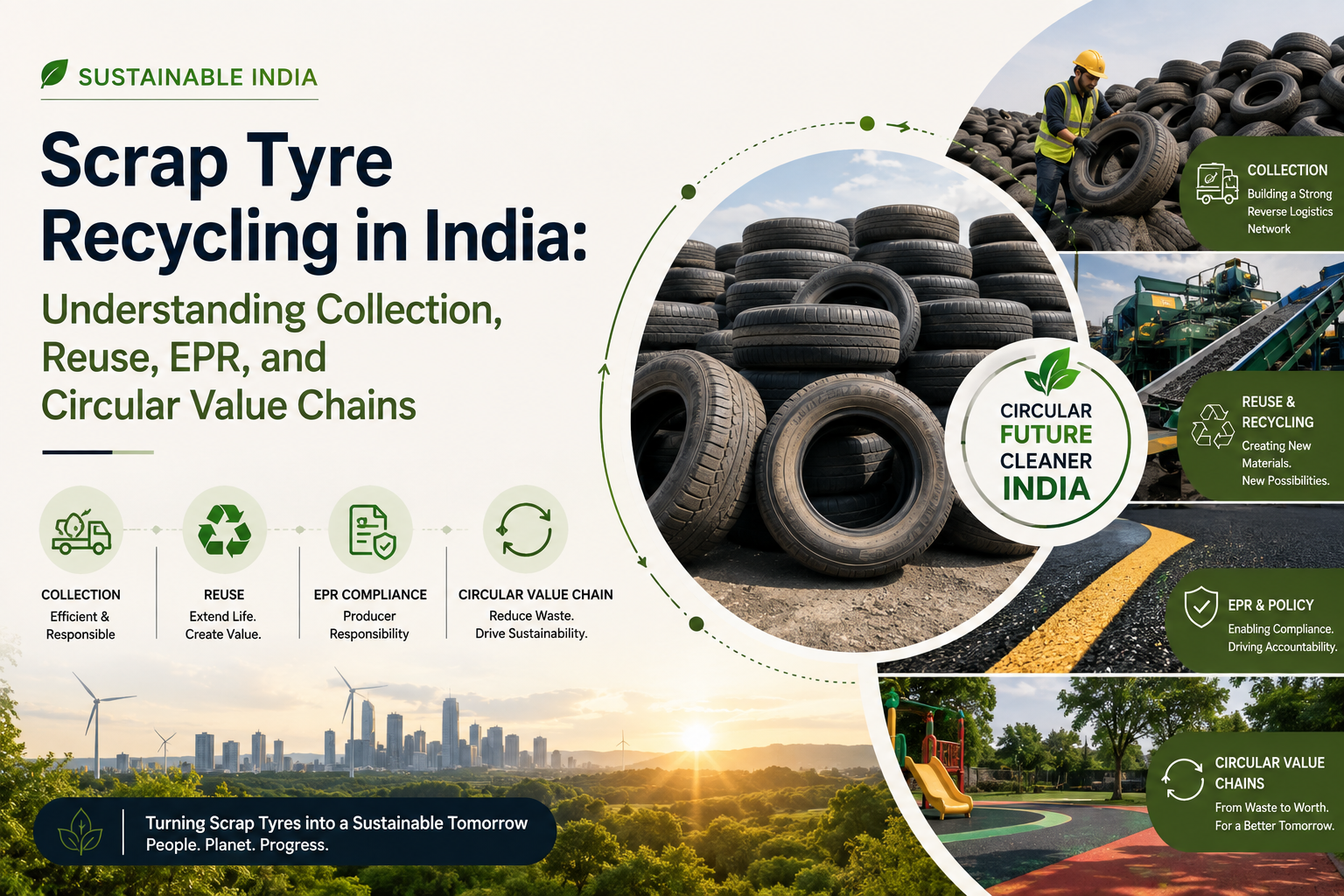
India generates large quantities of end-of-life tyres every year, creating challenges around collection, safe processing and material recovery. As waste tyre management becomes more organised, recycling and reuse are becoming increasingly important parts of the tyre lifecycle.
This guide covers the rubber scrap and tyre recycling landscape in India, what happens to tyres when they are recycled, how your scrap is valued, the EPR rules that apply to tyre waste, and how to connect with reliable buyers.
India’s Waste Tyre Challenge
India is among the world’s largest automobile markets and adds millions of new vehicles to its fleet every year. Each vehicle produces worn-out tyres at regular intervals, passenger car tyres every 3–5 years, truck and bus tyres more frequently. The cumulative waste tyre volume is substantial.
The problems with unmanaged tyre waste are well-documented:
-
Fire hazard: Waste tyre stockpiles are extremely difficult to extinguish and produce toxic smoke when they burn.
-
Public health risk: Tyre piles create mosquito breeding grounds, contributing to dengue and malaria transmission.
-
Toxic emissions: Burning tyres informally releases carcinogenic compounds including dioxins, furans, and polycyclic aromatic hydrocarbons.
-
Resource loss: Valuable materials, steel, rubber polymer, carbon black, and textile fibres, are lost when tyres are not properly processed.
At the same time, waste tyres contain recoverable materials such as rubber, steel and carbon-based compounds. Proper processing can divert these materials from disposal and return them to productive use.
The Regulatory Framework: Waste Tyre EPR in India
Waste tyre management in India is governed by the Hazardous and Other Wastes (Management and Transboundary Movement) Rules, 2016, as amended in 2022. India introduced a dedicated Extended Producer Responsibility (EPR) framework for waste tyres on 21 July 2022 through amendments to these rules.
Under the framework, producers and importers have obligations related to the environmentally sound management of waste tyres. The system also provides for registration of relevant stakeholders, recycling targets, EPR certificate generation and transfer, and reporting through the CPCB’s online Waste Tyre EPR system.
As of 5 March 2026, 579 recyclers were registered under the Waste Tyre EPR framework. Government data reported 122.29 lakh MT of tyre waste recycled and 116.94 lakh MT of EPR certificates generated.
Who Has EPR Obligations
Under the Waste Tyre EPR framework, obligations may apply to producers and importers covered by the rules, including entities manufacturing new tyres in India, importing new or used tyres, selling tyres under their own brand, and importing vehicles fitted with new tyres. The applicable obligation depends on the entity’s category and the quantity of tyres manufactured or imported.
Compliance Mechanism
Producers fulfil their applicable Waste Tyre EPR obligations through the mechanism prescribed under the 2022 rules, including the purchase and adjustment of eligible EPR certificates through the CPCB online system.
How Waste Tyre EPR Certificates Work
Registered recyclers can generate eligible EPR certificates in accordance with the applicable rules and CPCB requirements. Obligated entities may use eligible certificates toward their prescribed EPR obligations.
The mechanism is designed to create a market-based incentive for compliant recycling and encourage investment in formal waste tyre processing capacity. EPR certificates are subject to the conditions and validity periods prescribed under the applicable rules and CPCB framework.
Retreading: Extending Tyre Life Before Recycling
Not every end-of-life tyre needs to go directly into material recycling. Tyres with suitable structural integrity may be retreaded, extending their useful service life before eventual recycling.
Retreading replaces the worn tread while retaining the suitable casing. Under the Waste Tyre EPR framework, retreading is recognised separately from recycling, and eligible retreading certificates can form part of the prescribed EPR mechanism.
This makes retreading an important part of a circular tyre value chain: reuse the tyre casing where technically and economically viable, then recover materials when the tyre finally reaches end-of-life.
What Recycled Tyre Products Are Produced in India
When a waste tyre is recycled through a formal processing facility, it yields several distinct product streams.
Crumb Rubber
Shredding and granulating waste tyres produces crumb rubber, granules of various mesh sizes (from coarse chips to fine powder). Crumb rubber is used in:
-
Sports surfaces: Running tracks, artificial turf infill, gymnasium flooring
-
Playground safety surfaces: Impact-absorbing flooring
-
Rubberised asphalt: For road construction, can improve road life and reduce maintenance costs
-
Rubber moulded products: Including tiles, mats, and bumpers
-
Automotive components: Seals and vibration dampening components
Tyre Pyrolysis Oil
Pyrolysis, heating tyres in the absence of oxygen, thermally decomposes the rubber into products such as tyre pyrolysis oil, recovered carbonaceous material, steel, and process gas. Tyre-derived fuel (TDF) is a separate term generally used for tyres or tyre-derived material used directly as fuel, rather than for pyrolysis oil.
Pyrolysis can produce tyre-derived oil, carbonaceous char that may be further processed into recovered carbon black (rCB), steel and process gas, depending on the technology and feedstock.
Recovered Carbon Black (rCB)
Carbon black recovered from tyre pyrolysis, when properly processed and refined, can substitute for virgin carbon black in rubber compounding and coatings applications. Recovered carbon black is gaining commercial traction as sustainability mandates drive tyre manufacturers and rubber product makers to incorporate recycled content.
Steel Wire and Textile Fibre
The steel bead wire and belt layers in tyres are separated during shredding and sold as steel scrap. Textile cord fibres recovered from the tyre structure find uses as alternative fuel or insulation material.
The Tyre Recycling Process, Step by Step
Collection and Sorting
Waste tyres are collected from dealers, automotive service centres, fleet operators, and municipal collection points. Tyres are sorted by size and type, passenger car, truck/bus, and OTR (off-the-road), as processing parameters differ by size and construction.
Shredding
Whole tyres are fed into primary shredders that reduce them to large chips (100–300mm). Secondary shredding reduces chips further to granules (10–50mm). Granulators and crumb mills then reduce material to fine crumb rubber of specified mesh sizes for end-product applications.
Steel and Textile Separation
During granulation, magnetic separators extract steel wire and bead wire. Textile cord fibres are separated through aspiration systems. Both steel and textile streams are processed separately.
Pyrolysis (Alternative Pathway)
For tyres processed through pyrolysis, shredded material is fed into a reactor vessel. Pyrolysis reactors typically operate within a controlled temperature range, with the exact operating conditions varying by reactor design, feedstock, and process configuration. The exact process conditions depend on the reactor technology, feedstock characteristics and operating configuration.
Product Finishing and Quality Control
Crumb rubber is screened and classified to product specification. Pyrolysis oil is filtered and quality-tested before sale. Recovered carbon black char is refined where commercial-grade rCB is targeted.
Types of Rubber Scrap, What Buyers Procure
Beyond end-of-life tyres, rubber scrap procurement covers a range of rubber waste streams generated by industry:
-
Waste passenger car and two-wheeler tyres
-
Truck, bus, and OTR (off-the-road) tyres
-
Industrial rubber waste: Conveyor belts, rubber hoses, gaskets, and seals from manufacturing operations
-
Rubber compounding waste: Off-spec or trim waste from rubber product manufacturers
-
Retreading waste: Buffings and shearings from tyre retreading operations
Bulk quantities may attract more competitive pricing because collection, transportation, sorting, and processing can become more efficient at scale. Actual pricing depends on material type, quality, contamination, location, volume, and prevailing market conditions.
Tyre Recycling in India, Industry Landscape
India’s tyre recycling ecosystem includes authorised recyclers, retreaders, material-recovery operators and other processing businesses, alongside informal collection and processing activity in parts of the market.
Key challenges facing the sector include:
-
Inconsistent tyre collection infrastructure, particularly outside major urban centres
-
Competition from informal operators who process tyres without environmental controls
-
Variable quality of pyrolysis oil and rCB from small-scale processors limiting market development
-
Implementation challenges and uneven enforcement: Although a formal Waste Tyre EPR framework has been in place since 2022, gaps in collection infrastructure, compliance capacity, and sector formalisation continue to create challenges for the industry.
Further implementation of the Waste Tyre EPR framework may encourage more organised collection, better record-keeping and investment in compliant processing facilities.
Managing Rubber Scrap and Waste Tyres
Businesses generating waste tyres or other rubber scrap should first identify the material type, approximate volume and location. From there, they can approach authorised or appropriately registered recyclers and discuss material specifications, collection logistics and documentation requirements. For regular volumes, a scheduled collection arrangement may be more practical than one-off disposal.
Compliance Strategies for Tyre Waste EPR
-
Registration and reporting: Businesses covered by the Waste Tyre EPR framework should complete the applicable registration and reporting requirements through the CPCB Waste Tyre EPR portal and maintain supporting records as required under the applicable rules.
-
Recycler partnerships: Producers and importers can work with registered and compliant recyclers to support fulfilment of applicable EPR obligations.
-
EPR certificates: Where applicable, obligated entities can use eligible EPR certificates generated through the prescribed CPCB mechanism to meet their EPR obligations.
For more information on the CPCB Waste Tyre EPR framework, visit the CPCB Waste Tyre EPR Portal.
Why Tyre Waste EPR Matters
Waste Tyre EPR creates a formal mechanism for assigning responsibility for end-of-life tyre management and provides economic incentives for compliant recycling. It also supports greater traceability, formalisation of recycling activity, and investment in recycling infrastructure.
Future Outlook: Circular Economy Integration
The sector is likely to focus increasingly on better collection systems, improved material recovery and consistent quality of recycled products. Developments in crumb rubber, recovered carbon black, steel recovery and environmentally controlled processing could further strengthen the role of waste tyres in India’s circular economy.
Frequently Asked Questions
Are waste tyres covered under EPR regulations in India currently?
Yes. India notified the Waste Tyre EPR framework on 21 July 2022 through amendments to the Hazardous and Other Wastes (Management and Transboundary Movement) Rules, 2016. The framework establishes EPR obligations and a CPCB-operated online mechanism for registration, compliance and EPR certificate management.
What is tyre pyrolysis oil used for?
Tyre pyrolysis oil (TPO) is a liquid product generated through the thermal decomposition of waste tyres in the absence of oxygen. Depending on its quality, treatment and applicable regulatory requirements, it may be used in suitable industrial applications. Its composition and permitted use can vary by process and end-use requirements.
What is recovered carbon black (rCB) from tyre recycling?
Recovered carbon black is a co-product of tyre pyrolysis that can substitute for virgin carbon black in rubber compounding, coatings, and pigment applications. High-quality rCB requires further processing to remove impurities and achieve consistent particle size and surface area characteristics comparable to virgin grades.
Can organised buyers collect waste tyres from my premises?
Organised buyers’ rubber scrap procurement covers bulk generators including automotive dealers, fleet operators, industrial plants, and tyre manufacturers. Collection logistics are discussed on a case-by-case basis depending on volume and location.
How does tyre recycling contribute to the circular economy?
Tyre recycling is a core circular economy activity, recovering rubber polymer, carbon black, and steel from end-of-life products and returning them to productive use. This approach helps industrial clients design waste recovery strategies across multiple material streams.
Conclusion
India’s waste tyre sector is gradually moving toward more organised collection, processing and compliance. For businesses handling end-of-life tyres, understanding the applicable EPR requirements and working with appropriate recycling channels can help improve both regulatory preparedness and material recovery.
As recycling technologies and collection systems develop, greater quantities of rubber, steel and other tyre-derived materials can be recovered and returned to productive use.